
AI Overviews and chat assistants are quickly becoming the new front door to your brand.
People ask Google’s AI Overviews, ChatGPT, Claude, Perplexity, Gemini, and Copilot things like:
- “What’s the best [tool] for X?”
- “Which companies are trusted for Y?”
- “What’s a good alternative to [competitor]?”
If you’re not being mentioned in those answers—or you have no idea whether you are—you’re already behind. The problem is that Google Search Console and most analytics tools don’t tell you when AI assistants are citing your brand or sending traffic.
That’s where a new stack of tools comes in: platforms that monitor how often your brand is mentioned across AI Overviews and chat assistants, what’s being said, and which competitors are stealing the spotlight. This guide walks through the most useful tools right now and how to build a simple AI visibility stack that actually ties back to traffic and revenue.
What You Actually Want to Track in AI Search
AI visibility isn’t just “rankings in a new UI.” You’re trying to answer a very specific set of questions:
- Where is my brand mentioned? In Google AI Overviews / AI Mode and in answers from ChatGPT, Claude, Gemini, Perplexity, Copilot, and other assistants.
- How often am I cited or recommended? Are you a primary recommendation, a throwaway mention at the end, or missing entirely?
- How do I compare to competitors? What’s your share of voice versus the other brands in your category when people ask AI for “best tools,” “top platforms,” “[competitor] alternatives,” and so on.
- Which prompts and topics trigger my brand? You want to know the actual questions that make AI mention you, and the related topics where you’re consistently ignored.
- What’s the narrative and sentiment? Are AI models describing you accurately, or repeating outdated pricing, features, or positioning?
- Is AI-driven traffic actually growing? Are people clicking through from AI Overviews or assistant answers, and does that traffic convert?
The tools below help you answer some or all of those questions so you can treat AI search like a real channel—not a black box.
The Best Tools to Track Brand Mentions Across AI Overviews and Chat Assistants
Most of the market fits into three buckets:
- SEO-first platforms that added AI Overview and AI search visibility modules
- Dedicated GEO (Generative Engine Optimization) platforms built specifically for AI answers
- Native or hybrid tools that live inside your CMS or analytics stack
1. SE Ranking – AI Results Tracker & AI Visibility Toolkit
Best for: SEO teams that want AI Overviews data right next to traditional rankings.
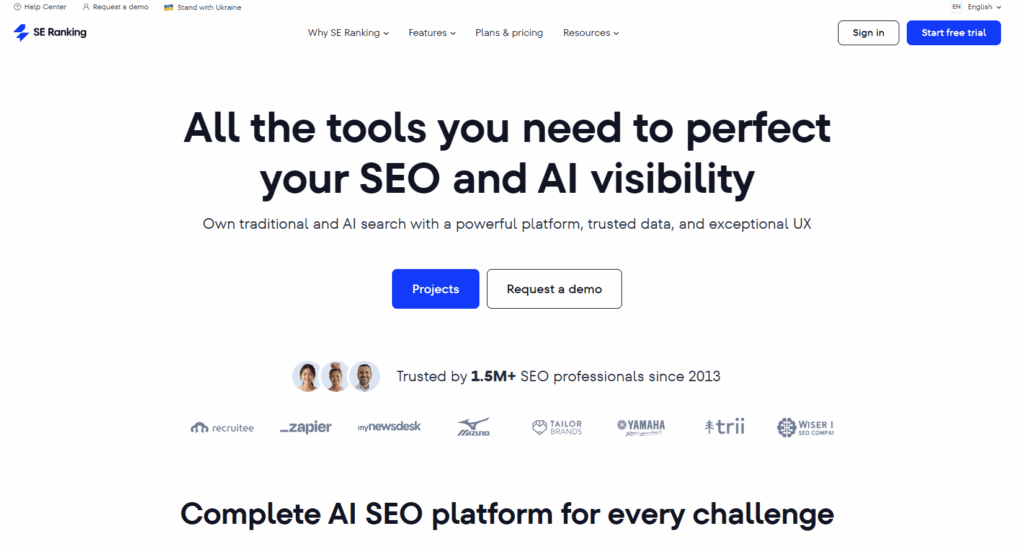
SE Ranking was one of the first all-in-one SEO platforms to ship an AI Results / AI Overviews Tracker. It lets you see exactly which of your tracked keywords trigger Google AI Overviews or AI Mode and whether your domain (or your competitors) is cited in those AI answers.
More recently, SE Ranking has expanded to include AI visibility across multiple engines, so you can monitor how often you show up in AI experiences alongside your classic SERP positions.
Standout features:
- Project-based tracking so AI visibility is tied to the same keyword sets you already use for SEO.
- Snapshot of AI answers, including which URLs are cited and what format they appear in (lists, cards, paragraphs).
- Competitor visibility that reveals prompts where rival domains are cited and you’re missing.
How to use SE Ranking for AI visibility:
- Add your existing SEO keyword set as a new project.
- Enable AI Results / AI Overviews tracking for your highest-intent keywords.
- Pull a report that shows:
- Which queries trigger an AI Overview
- Whether your domain is cited and which URL is used
- Sort by:
- High-value queries where AI appears and you’re missing entirely
- Queries where you’re cited but competitors are more prominent
That prioritized list becomes your AI-focused content roadmap—starting with pages that already generate revenue but are invisible or underrepresented in AI answers.
2. seoClarity – AI Overviews Tracking & AI Search Visibility
Best for: Enterprise SEO teams and large content sites with huge keyword sets.

seoClarity has built a full AI Overviews and AI search visibility suite on top of its massive rank tracking infrastructure. It’s designed for sites that track tens of thousands to millions of keywords and need statistically meaningful patterns—not just a few screenshots.
Standout features:
- AI Overview detection at scale: see which of your tracked keywords now show AI Overviews or AI Mode.
- Full AI answer capture: store the generated summary, cited domains, and images for analysis.
- Traffic impact modeling: compare CTR and traffic when AI appears vs. when it doesn’t.
- Competitive benchmarking: spot where competitors are being cited while you’re absent.
How to use seoClarity for AI search:
- Segment your highest-converting keywords by revenue or leads.
- Use seoClarity to flag which of those now trigger AI Overviews.
- Identify:
- Keywords where AI Overviews appear and you’re not cited.
- Keywords where AI Overviews coincided with a drop in organic traffic.
- Prioritize updates and new content for queries that drive profit and are now mediated by AI answers.
If you’re an enterprise publisher, this becomes the backbone of your “what did AI do to our SEO?” reporting.
3. Profound – Cross-Engine AI Visibility Command Center
Best for: Brands that want a single pane of glass for AI mentions across multiple engines.
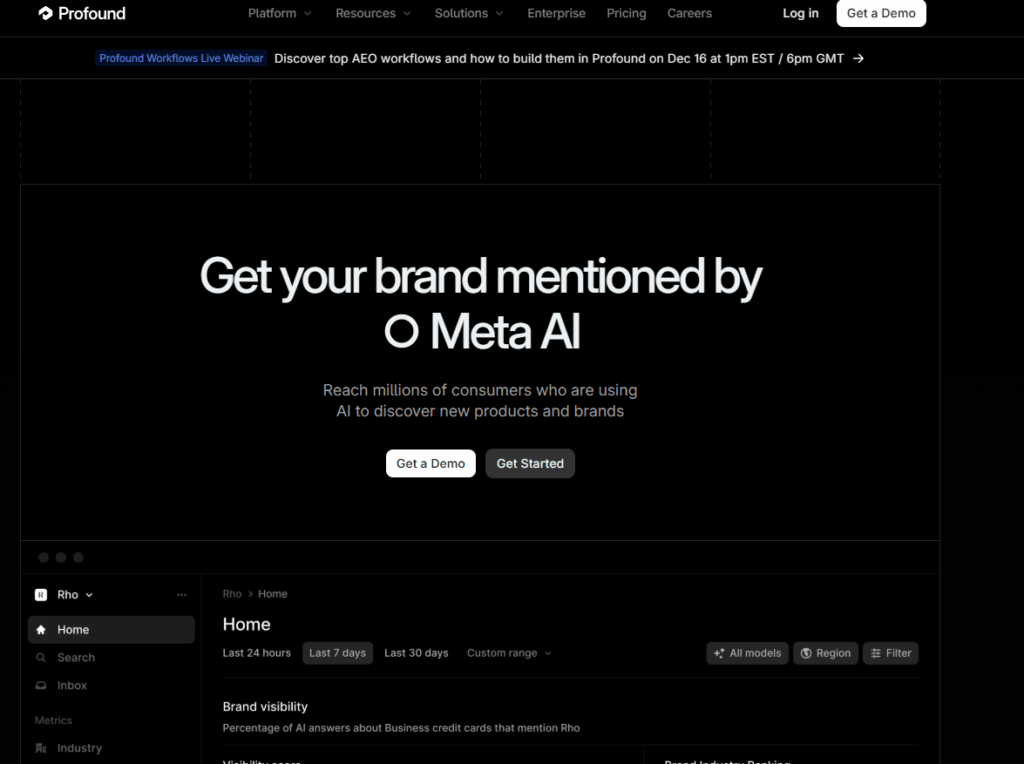
Profound is a GEO-first platform focused almost entirely on AI visibility. Instead of starting from traditional rankings, it starts from AI-generated answers and works backward to show you where and how your brand is appearing.
What it tracks:
- Brand mentions across Google AI Overviews / AI Mode, ChatGPT, Claude, Gemini, Perplexity, Copilot, and other major assistants.
- Which prompts, questions, and topics tend to surface your brand.
- Share of voice and narrative vs. a competitor set you define.
- Accuracy and sentiment of how AI describes your product or service.
How to use Profound:
- Set up your brand and 3–5 direct competitors.
- Run a baseline across engines to see where you’re strong and where you’re invisible.
- Identify three types of gaps:
- Engines where you never appear (e.g., strong in Google AI Overviews, weak in ChatGPT).
- High-intent prompts where competitors dominate the answer.
- Places where AI is misrepresenting your pricing, positioning, or feature set.
- Feed those insights into content updates, PR efforts, digital PR, and product positioning work.
Profound is overkill for some small sites, but if your brand lives or dies on category-level perception, it gives you the cleanest “who owns the AI answer” view right now.
4. Geoptie – Free GEO Tools and GEO Rank Tracker
Best for: Teams that want a dedicated AI rank tracker and GEO toolkit with a low barrier to entry.

Geoptie is a GEO-focused platform built around four core tools, including a GEO Rank Tracker that monitors your visibility across AI assistants like ChatGPT, Claude, Gemini, Perplexity, and Bing’s AI experiences.
Alongside the rank tracker, Geoptie offers a GEO Audit, GEO Content Checker, and GEO Keyword Finder—so you get both monitoring and practical optimization advice.
Standout features:
- Location-based AI tracking to see how your AI visibility shifts by country or region.
- Free or freemium access to several tools, which is rare in this space.
- Actionable audits that flag structural and content issues holding back AI citations.
How to use Geoptie:
- Run a GEO Audit on your main domain to see whether AI systems can easily understand, trust, and cite your content.
- Set up GEO Rank Tracker for your brand and top competitors across key AI engines.
- Use the GEO Content Checker and GEO Keyword Finder to refine structure, FAQs, and on-page language around the prompts that actually matter.
If you’re just starting to care about AI visibility and don’t want to rip out your SEO stack, Geoptie is a solid way to get oriented.
5. Similarweb – AI Brand Visibility Inside a Traffic Intelligence Platform
Best for: Teams already using Similarweb for market and traffic intelligence.
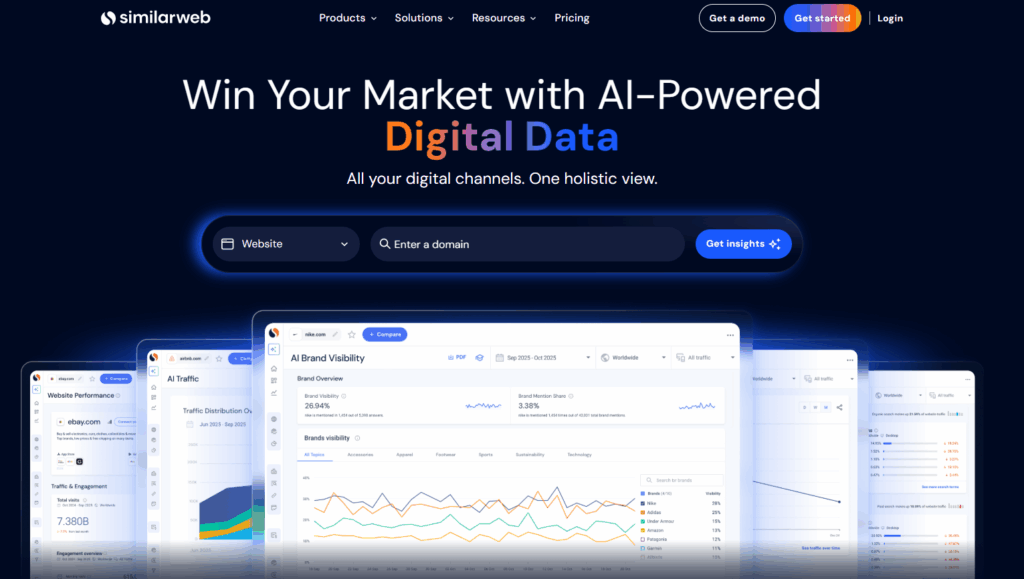
Similarweb has introduced AI visibility capabilities alongside its core traffic and competitive data. Instead of obsessing over individual prompts, you see AI-driven traffic and visibility in the broader context of your acquisition channels.
What it adds to your stack:
- Estimated traffic from AI-driven surfaces.
- Top topics and queries where AI-origin traffic starts.
- Competitive comparisons so you can see whether others in your space are getting more benefit from AI exposure.
Think of Similarweb as your “does this matter financially?” filter. Other tools show you raw AI mentions; Similarweb helps confirm whether those mentions translate into meaningful visits and sales.
6. Writesonic – AI Visibility + GEO Content Engine
Best for: Brands that want monitoring, optimization ideas, and AI writing in the same ecosystem.
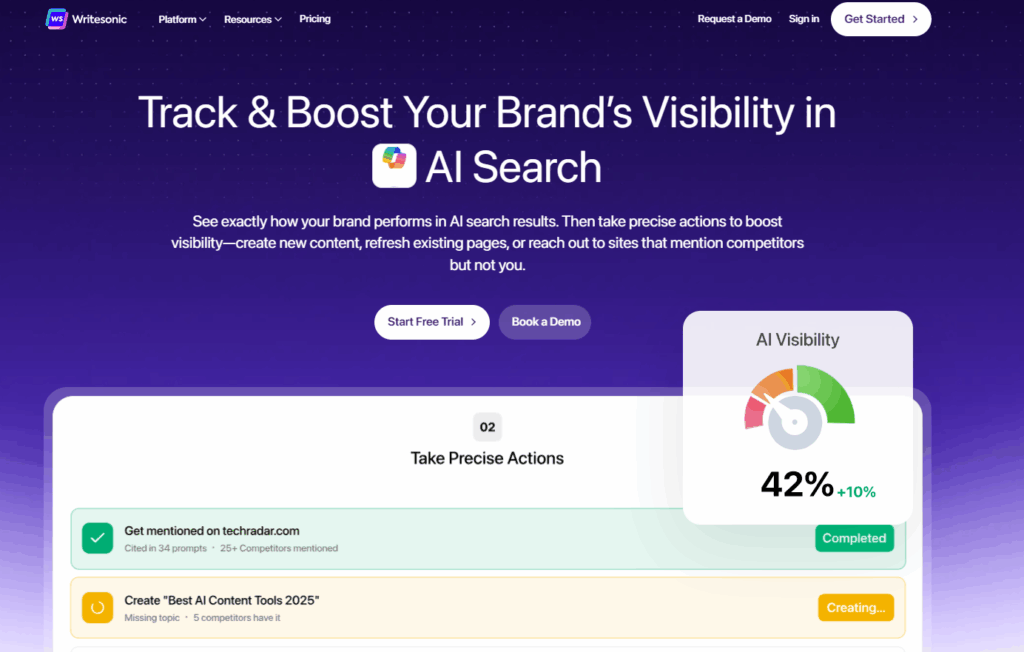
Writesonic has shifted from “AI copy tool” to a broader AI visibility and GEO platform. It offers:
- AI visibility tracking across ChatGPT, Gemini, Perplexity, and other platforms.
- Brand presence and sentiment monitoring so you can see how your brand is framed.
- Content generation and refresh workflows tuned specifically for GEO, not just traditional SEO.
How to use Writesonic:
- Run brand visibility scans to identify high-value prompts where you appear rarely or not at all.
- Use its content engine to:
- Fix inaccurate narratives that AI keeps repeating.
- Expand and modernize outdated articles that should be feeding AI answers.
- Re-scan regularly to confirm whether the new content is increasing citation frequency and improving sentiment.
This is one of the more opinionated platforms: it gives you concrete “do this next” recommendations tied directly to AI visibility gaps.
7. Wix – AI Visibility Overview (for Wix Sites)
Best for: Small and mid-sized businesses already running their sites on Wix.
If your site is on Wix, you now get GEO-style insights without installing new tools. Wix’s AI Visibility Overview is built into its analytics layer and shows how your site appears across AI platforms like ChatGPT, Gemini, and Perplexity.
Highlights:
- AI citations overview: how often your site is used in AI answers.
- Brand sentiment and narrative monitoring.
- Competitive benchmarks for AI visibility within your niche.
- AI-driven traffic and query volume estimates.
If you’re a Wix user, treat this as your default AI search dashboard. It’s not as deep as some dedicated GEO platforms, but it removes all the friction of adding yet another SaaS to your stack.
8. Surfer – AI Tracker Add-On for Existing Surfer Users
Best for: Teams already using Surfer for content optimization who want a simple AI visibility layer.
Surfer offers an AI Tracker add-on that integrates directly with your existing content planning and optimization workflows. It’s designed to show:
- Where and how often AI tools mention your brand across buyer-intent prompts.
- Which of your URLs get cited in AI answers.
- How your AI visibility changes over time as you ship new content.
How to use Surfer AI Tracker:
- Activate AI Tracker for your main brand and top products.
- Pair each tracked cluster in Surfer (e.g., “best email marketing tools”) with AI Tracker data to see whether AI is actually using those pages.
- Use weekly or monthly reports to:
- Identify content that nearly gets cited and needs a structured refresh.
- Spot engines or prompt types where you’re invisible and create new clusters around them.
For existing Surfer users, this is the least disruptive way to start caring about GEO.
How to Choose the Right AI Visibility Stack
You don’t need every tool on this list. In fact, stacking too many will just give you conflicting dashboards and no clear direction. Instead, build the smallest stack that answers your most important questions.
If You’re a Solo Founder or Very Small Team
Your priorities are simplicity, cost, and proving that AI visibility actually matters for your business.
- Start with Geoptie’s free tools to get a baseline on AI visibility and run a GEO audit.
- If you already use a platform like SE Ranking or Surfer, enable their AI visibility modules rather than adding something entirely new.
- Set a 60–90 day test window where your only goal is to:
- Measure where you appear in AI answers now.
- Ship a handful of focused content improvements.
- See if your AI mentions—or AI-driven traffic—move at all.
If You’re a Growing SaaS or Ecommerce Brand
You care about category perception, competitor positioning, and tying AI exposure back to paid and organic funnels.
- Pair one SEO-first platform with one GEO-focused platform:
- Use seoClarity or SE Ranking for AI Overviews and traffic impact.
- Use Profound, Geoptie, or Writesonic for cross-engine AI mentions and prompt-level insights.
- Wire the most important metrics (share of voice in AI answers, AI-origin sessions, conversions) into your regular performance reviews—so AI visibility isn’t just a fun side project.
If You’re Enterprise or Heavily Content-Driven
At this scale, AI visibility is a channel you’ll manage alongside SEO, paid search, and social—not a one-off metric.
- Choose an AI visibility “system of record” like seoClarity, Profound, Similarweb, or Writesonic.
- Push AI mention data into your data warehouse and BI dashboards so you can:
- Correlate AI visibility with branded search, direct traffic, and pipeline.
- Assign ownership and KPIs to SEO, content, and comms teams.
- Treat AI assistants like a set of new “review sites” that you manage strategically, not reactively.
A 90-Day Plan to Turn AI Visibility into a Real Growth Channel
To keep this actionable, here’s a simple 90-day plan you can run almost entirely with the tools above.
Weeks 1–2: Baseline and Setup
- Pick one primary AI visibility tool (plus one supporting tool if needed).
- Define 20–50 high-intent queries:
- “best [category] tools”
- “[competitor] alternatives”
- “which [category] for [use case]”
- Run baseline checks across:
- Google AI Overviews / AI Mode
- ChatGPT, Claude, Gemini, Perplexity, Copilot (where supported)
- Document:
- Where you’re cited.
- Where you’re missing.
- Where competitors dominate.
Weeks 3–6: Fix Gaps and Strengthen Your Story
- Group opportunities into three buckets:
- High-value queries with AI answers where you’re invisible.
- Queries where you’re present but clearly second choice.
- Queries where AI is using outdated or weak messaging about you.
- For each bucket, ship 1–2 concrete actions:
- Deep rewrites or net-new pages that fully answer the AI-style questions.
- Comparison pages that clearly position you vs. competitors.
- Updated product, pricing, and feature content with clean structure, FAQs, and schema markup.
- Use your GEO tools to sanity-check that your updates are easy for AI models to parse and cite.
Weeks 7–12: Measure, Attribute, and Scale
- Re-run AI visibility checks to see:
- Whether your citation rate is improving.
- Whether your brand is moving up inside AI answers.
- Use analytics to track:
- Changes in branded search and direct traffic.
- Any referrers or query patterns that clearly tie back to AI platforms.
- Double down where you see movement:
- Engines where visibility is climbing.
- Topics that now drive more signups, trials, or sales.
Once you’ve run this loop once, you’ll have something most of your competitors don’t: a repeatable process to measure, improve, and defend your visibility across AI Overviews and chat assistants. At that point, AI search stops being a scary unknown and turns into another channel you can deliberately win.