
Dedicated hosting is built for sites and apps that have outgrown shared or VPS resources, or teams that need full control over OS, security, and performance tuning. If you want bare-metal power without juggling sysadmin work, look for managed dedicated plans that include patching, monitoring, backups, and hands-on support.
Below you’ll find recommendations that work for solo founders, fast-growing stores, and established teams. Once you experience the stability, security, and speed of your own dedicated server, it’s tough to go back.
The Best Dedicated Hosting Plans for 2026
- Bluehost — Best overall dedicated hosting plan for value, onboarding, and simplicity
- Atlantic.Net – Best for Compliance-Ready Dedicated Servers
- HostGator — Most reliable uptime with unmetered bandwidth
- InMotion — Best small-business dedicated hosting with white-glove setup
- Hosting.com (formerly A2 Hosting) — Fastest dedicated hosting for developers and performance-first teams
After the reviews, jump to the quick explainer on dedicated hosting. If you already know the basics, dive right into the top picks below.
Bluehost – Best Overall Dedicated Hosting Plan
Bluehost pairs approachable pricing with hardware that’s more than enough for most growing sites. It’s a strong fit if you want dedicated performance without a steep learning curve.
You can scale resources as you grow and manage shared, VPS, and dedicated servers from a single dashboard. cPanel/WHM, free SSL, and root access make it easy to customize while keeping day-to-day tasks simple.

Bluehost’s long track record and 24/7 expert support are the main draws. Prefer full control? You get complete autonomy and root access. Want a safety net? Dedicated customers receive expedited help when things get urgent.
Bluehost now organizes dedicated plans by NVMe tiers. Here’s the current lineup (all include unmetered bandwidth, 3 dedicated IPs, and a free domain for the first year on qualifying terms):
Standard NVMe 32
- Renewal pricing from ~$176.79/mo on 24–36-month terms (monthly renews at ~$194.47).
- 8 CPU cores, 1 TB NVMe, 32 GB RAM, 3 IPs.
Enhanced NVMe 64
- Renewal pricing from ~$259.19/mo on 24–36-month terms (monthly renews at ~$285.11).
- 16 CPU cores, 2 TB NVMe, 64 GB DDR5 RAM, 3 IPs.
Premium NVMe 128
- Renewal pricing from ~$379.18/mo on 24–36-month terms (monthly renews at ~$417.11).
- 32 CPU cores, 3 TB NVMe, 128 GB DDR5 RAM, 3 IPs.
As always, intro/sign-up promos vary by term and can be lower than the renewal figures above—confirm the final rate at checkout.
Atlantic.Net — Best for Compliance-Ready Dedicated Servers

Atlantic.Net is a strong pick if you want serious dedicated hardware, strict uptime guarantees, and infrastructure that’s already built for compliance-heavy workloads. They’ve been in business for 30+ years and focus on U.S.-based dedicated servers backed by audited data centers and always-available support.
Atlantic.Net’s dedicated servers are custom-built to your specs with a choice of Intel Xeon or AMD EPYC processors, SSD or NVMe storage, and plenty of RAM. Every machine comes with full root access, a dedicated IP, free SSL, and support for popular control panels, so you can run everything from high-traffic WordPress and ecommerce sites to custom apps and databases on one box.
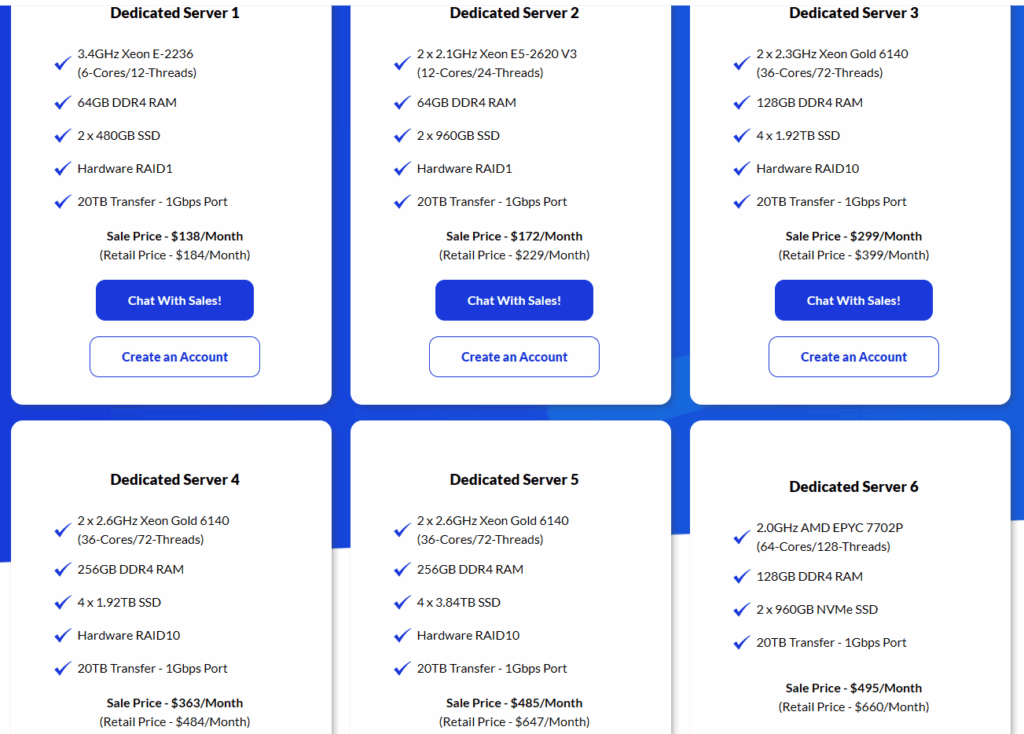
Example plans include 6-core Xeon E-2236 servers with 64 GB RAM and dual SSDs starting around the low-$100s per month on sale, and high-end dual Xeon Gold or EPYC servers with up to 36 or 64 CPU cores, 128–256 GB RAM, and RAID-10 SSD storage for heavier enterprise workloads. Atlantic.Net also advertises 36-core dedicated servers as low as around $199 per month when you commit to longer terms, with discounts up to about 30% for extended contracts.
Key reasons to choose Atlantic.Net for dedicated hosting:
- High-performance hardware: Latest-generation Intel Xeon and AMD EPYC CPUs, large RAM allocations, and SSD or NVMe storage tuned for high-traffic sites, databases, and apps.
- Custom server builds: Pick CPU, disk type, and memory, plus operating system (Windows or Linux) and control panel options, or have their team design a custom configuration for you.
- 100% uptime SLA: Atlantic.Net backs its network, hardware, and critical infrastructure with a 100% uptime guarantee, so dedicated customers aren’t guessing about reliability.
- Compliance-ready data centers: AICPA SOC 2 and SOC 3 certified facilities with PCI-, HIPAA-, and HITECH-ready infrastructure for businesses that handle sensitive data.
- Unlimited inbound bandwidth: All dedicated hosts include unmetered inbound traffic, plus generous outbound transfer on 1 Gbps ports for high-volume sites.
- Flexible management options: Run the server yourself with full root/admin access, or bolt on managed services like firewalls, backups, intrusion detection, CDN, and DDoS protection.
- USA-based, 24/7/365 support: English- and Spanish-speaking support teams and on-site technicians in multiple U.S. data centers, available around the clock.
If you’ve outgrown VPS or cloud instances and want fully dedicated hardware that’s still cost-effective, Atlantic.Net’s dedicated server lineup is a solid option—especially if compliance, uptime guarantees, and U.S.-based support are non-negotiable for your business.
HostGator – Most Reliable Dedicated Hosting
HostGator is a go-to for stable uptime, straightforward management, and responsive support. It’s a safe choice when consistency matters more than bleeding-edge hardware.
Raw speed isn’t its biggest claim, but the platform shines for reliability and unmetered bandwidth—great for traffic spikes, media libraries, and large backups.
Current regular (non-promo) pricing for Linux/Windows dedicated servers typically ranges from the Value (NVMe 32) tier up through Enterprise (NVMe 128), with the lowest monthly equivalent near ~$176–$188 on 36-month terms and month-to-month around ~$194–$206 for Value; Power and Enterprise scale up from there. Exact totals depend on term length and whether you include a control-panel license.
If you want a low-stress dedicated host with generous bandwidth and a proven track record, HostGator fits the bill.
InMotion – Best Dedicated Web Host for Small Businesses

InMotion nails the small-business sweet spot: predictable pricing, excellent support, and real help during onboarding.
Support is available via chat, phone, and email, and wait times are typically short. You’ll also get proactive help rather than just links to docs.
“Launch Assist” (now part of InMotion’s managed Premier Care) helps configure your server, set up domains and email, tune firewalls, and migrate sites—so you can launch faster and avoid costly mistakes.

Performance is strong (uptime and load times are consistently solid), and managed plans add monitoring, patching, and backup help—ideal if you don’t have a full-time admin. Managed dedicated pricing currently starts around $189.98/month for the Essential tier, with Advanced/Elite scaling up; bare-metal (self-managed) “Aspire/Essential/Advanced/Elite” plans start lower. Pricing varies by term and configuration.
If you don’t have in-house IT, InMotion’s managed option is the stress-free path: you get speed, security, backups, and attentive support—all tuned for small-business needs.
Bottom line: InMotion is a smart pick when you want dedicated horsepower with a partner mindset.
If you’re upgrading from shared or VPS and want a smooth landing, choose InMotion for the extra guidance during setup and migration.
Hosting.com (formerly A2 Hosting) – Fastest Dedicated Hosting
Hosting.com (the new brand for A2 Hosting) remains a favorite among developers for speed and flexibility, with NVMe options and root access across tiers.
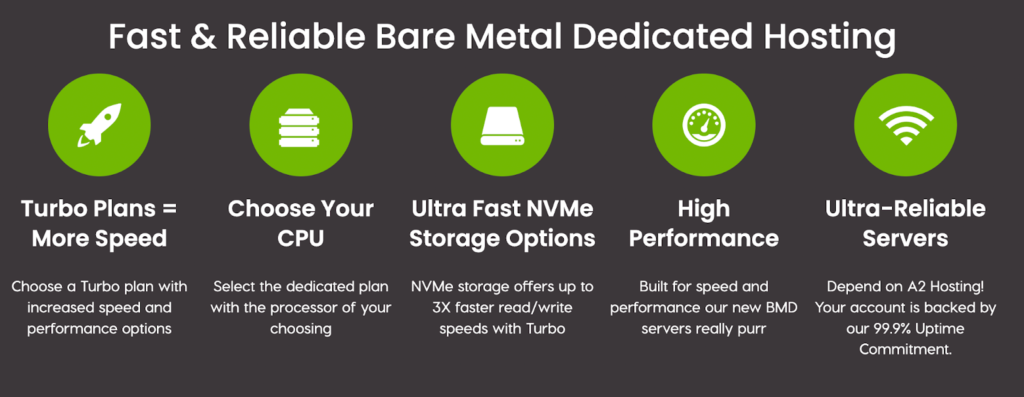
Plan names are unchanged (Unmanaged “Hyper” and Managed “Warp”), and typical starting prices you’ll see advertised in 2026 fall roughly in these bands, depending on term and promos: Hyper from around the low-$100s, Warp from the high-$100s. Confirm specs and final term pricing at checkout.
If you want fast, developer-friendly dedicated hosting at sensible prices, Hosting.com is a standout.
What is Dedicated Hosting?
Dedicated hosting gives you an entire physical server—CPU, RAM, storage, and bandwidth—reserved for your workloads. With no noisy neighbors, you get consistent performance and the freedom to configure everything from the OS and web server to firewalls and caching layers.
It differs from VPS and cloud hosting in two big ways: dedicated hardware (no shared hypervisor resources) and deeper control (root access, custom kernels, and more predictable I/O). The trade-off is higher cost and more responsibility for updates and security—unless you choose a managed plan.
Common use cases include high-traffic ecommerce, SaaS apps, enterprise WordPress, analytics pipelines, game servers, and workloads with strict compliance needs (PCI, HIPAA, or data-sovereignty requirements).
Who is Dedicated Hosting For?
Pick dedicated hosting when you have sustained traffic, complex apps, or compliance and security needs that exceed what VPS or shared plans can offer.
If you’re running a smaller site (a few thousand visits per month) or you’re still validating a project, a quality VPS will usually be enough. As you approach 50,000–100,000 monthly visits, run heavy database queries, or need strict isolation and custom security, a dedicated server starts to make sense.
It’s also a fit for teams handling sensitive data or regulated workloads, where you need predictable performance, dedicated IPv4s, and tighter control over network policies, backups, and audit trails.
Not sure whether to choose managed or unmanaged? Go managed if you want the host to handle patching, monitoring, backups, and hardware replacement. Choose unmanaged if you have in-house expertise and want full control with lower monthly costs.
Dedicated Hosting in Summary
If your current plan is choking under load or you need more control over performance and security, a dedicated server is the cleanest upgrade path. You’ll get isolation, consistent I/O, and the freedom to tailor your stack—especially valuable for larger sites and mission-critical apps.
Before you buy, compare: CPU generation and core count, ECC RAM capacity, SSD/NVMe vs. HDD and RAID (1 or 10), bandwidth and uplink speed, data-center locations, DDoS protection and WAF, snapshot/automated backups, SLA and hardware replacement times, OS and control-panel licensing, and whether you want managed or unmanaged support. Match the plan to your team’s expertise and your growth curve, and you’ll get the stability and peace of mind that dedicated hosting is known for.