
Coming up with a business idea is only the first step. Turning that idea into a real, compliant company can get confusing fast—especially with state-by-state rules, paperwork, and deadlines. The best business formation services simplify all of that with guided filings, compliance reminders, and optional add-ons like registered agent service, EIN registration, and operating agreements for your LLC, corporation, or nonprofit.
I spent weeks analyzing and comparing today’s leading providers. From 13 contenders, I selected 10 standouts that cover different budgets and needs—from fast, no-frills LLC filings to comprehensive legal and compliance help for growing companies. I focused on pricing transparency, ongoing support, and how well each platform helps you stay compliant after formation.
The Top 10 Best Business Formation Services in 2026
- LegalNature — Best business formation services overall
- LegalZoom — Best for full-service legal add-ons
- ZenBusiness — Best for business planning and branding
- Bizee — Best for LLC filing
- Northwest Registered Agent — Best for protecting your privacy
- Rocket Lawyer — Best for ongoing legal support
- Inc Authority — Best for managing your business after filing
- MyCompanyWorks — Best for quick business processing
- Harbor Compliance — Best for all-around compliance
- BizFilings — Best for entrepreneurs and startups
How to Choose the Right Business Formation Service (Step-by-Step)
Use this quick framework to match your needs to the right provider and avoid surprise costs. You’ll make a better choice if you look beyond promo pricing and focus on accuracy, total cost of ownership, and how much ongoing compliance help you actually want from your business formation service.
- Pick your entity first. Decide between LLC, corporation (C/S), or nonprofit. Confirm your state’s unique rules (publication, franchise taxes, name restrictions) so your provider supports them and can file correctly the first time.
- Decide your support level. DIY with document templates, guided online filing, or hands-on help with attorney access. The more complex your setup (multi-member, investors, multi-state), the more guidance you’ll want from a human-backed platform.
- Audit core inclusions. Look for registered agent options, EIN handling, operating agreement/bylaws, and compliance alerts. If they’re not in the base plan, note the add-on prices and whether they renew at higher rates in year two.
- Check turnaround reality. “Same-day” usually means the provider submits quickly; your state still controls approval. If you’re on a deadline, confirm state expedite options and fees and check current processing times for your state.
- Evaluate privacy. If you don’t want your home address or phone public, choose a provider that defaults to its info on filings and offers virtual address or mail scanning. This is especially important for home-based or online businesses.
- Compare true annual costs. Some services start cheap, then renew registered agent or compliance tools at higher rates. Put renewal pricing, not promos, into your budget so you know the real cost to keep your entity in good standing.
- Review support hours and channels. Phone, chat, and email availability—especially if you’ll be filing after work or across time zones—can save days of back-and-forth when a state rejects a filing or asks for clarification.
- Plan for post-formation. Licenses, annual reports, BOI/Beneficial Ownership updates, and tax setup matter just as much as day-one filing. Make sure the provider covers the whole lifecycle or integrates cleanly with the tools and advisors you already use.
Total Cost Checklist (No Surprises)
Tally these line items before you buy. Your “cheap” filing can double after renewals if you skip this step, especially with providers that bundle business formation, registered agent, and compliance into one subscription.
- State filing fee (varies widely by state)
- Base package price (intro offer vs. regular price)
- Registered agent (year one vs. renewal)
- EIN (free via IRS; paid if you want the provider to handle it)
- Operating agreement/bylaws and corporate kit
- Annual report/statement of information filing service
- Publication fees (only in certain states)
- Expedite fees (state + provider, if applicable)
- Mail forwarding/virtual address or privacy add-ons
Red Flags to Watch For
- Required add-ons you can’t remove just to reach checkout
- “Free” plans that auto-enroll you into high-cost renewals
- Hard-to-find cancellation terms or phone-only cancellations
- Data-sharing language that sells your info to third parties
- Vague turnaround claims without state-specific timelines
- Aggressive upsells or surprise monthly subscriptions that appear only at the final checkout screen
Quick Picks by Scenario
- Most founders: Start with a service that gives you affordable formation plus a deep document library and room to add compliance tools later.
- Privacy-first founder: Choose a registered agent specialist with virtual address and strict data policies so your personal address stays off public records.
- Heavily regulated or multi-state: Pick a compliance-focused provider with licensing tools and hands-on specialists who monitor changing rules for you.
- DIY power user: Go template-first with optional filing help and a robust document library so you can move at your own pace but still stay compliant.
- “Done-for-me” preference: Use a full-service platform that bundles filings, attorney access, tax help, and ongoing reminders into one dashboard.
Your First-Year Compliance Roadmap (What to Do After You File)
Formation is day one. The next 12 months determine whether you stay in good standing, protect your privacy, and avoid avoidable fees. Use this roadmap to move from “approved” to “fully operational” without missing critical deadlines or creating cleanup work later.
- Open your business bank accounts (Week 1–2). Bring your filed documents (Articles/Certificate), EIN letter, and operating agreement/bylaws. Keep business funds fully separate from personal funds to preserve liability protection and make bookkeeping straightforward.
- Adopt your internal documents (Week 1–2). For LLCs, sign the operating agreement; for corporations, adopt bylaws, issue shares, and record initial director/shareholder consents. Store everything in a central folder or your provider’s dashboard with clear naming and dates.
- Secure licenses and permits (Weeks 1–4). Check state, county, and city requirements (general business license, home-based permits, sales tax, professional licenses). If you’ll sell online or in multiple states, document where you have nexus and how you’ll collect and remit taxes.
- Register for state taxes (Weeks 2–4). This can include sales/use tax, employer withholding, and unemployment insurance. If you’ll run payroll soon, set this up before your first hire so you don’t miss early filing deadlines.
- Set your compliance calendar (Week 2–3). Add annual report/statement-of-information due dates, registered agent renewal, franchise taxes (where applicable), and license renewals. Block out reminders 30, 14, and 3 days in advance and share the calendar with anyone who helps with admin.
- Complete Beneficial Ownership filing (BOI) if required. Keep IDs and proofs on file for quick updates and file changes promptly if ownership, addresses, or ID details change.
- Decide on tax elections (First 2 months + 15 days from formation or tax year start). If S-Corp taxation makes sense, file Form 2553 on time. Missed elections can often be fixed, but on-time filings save hassle and CPA fees and keep your books cleaner.
- Document meetings and resolutions (Quarterly). Keep minutes/resolutions for major actions (opening accounts, signing leases, hiring officers, buying equipment). Clean records make banking, audits, financing, and exits easier.
- Review insurance and privacy (Month 1–2). Get general liability and, if relevant, professional liability or cyber. If you want to keep your home address off public records, use your registered agent’s address and consider a virtual office.
- Revisit your structure before your first big hire or investor (Month 3–6). Multi-member LLCs should confirm ownership percentages, vesting, and buy-sell terms. Corporations should confirm cap table hygiene before fundraising or granting equity.
Key Deadlines at a Glance
- Annual report/statement of information: Due dates vary by state (some by anniversary month, others by calendar date). Late filings usually trigger penalties and can lead to administrative dissolution.
- Registered agent renewal: Typically annual. If your RA resigns or you lapse on payment, your company can fall out of good standing and miss legal notices.
- BOI updates: If beneficial ownership reporting applies to your company, file required updates promptly after changes to owners, control persons, legal name, address, or ID numbers.
- Sales tax and payroll filings: Monthly or quarterly depending on volume and state rules. Put these on your calendar with buffer time for reconciliations.
- S-Corp election (if desired): File Form 2553 within 2 months and 15 days of formation or the start of the tax year you want the election to apply to.
State Quirks Worth Noting
- Publication requirements: A few states require you to publish notices after formation. If your state does, confirm which newspapers and timelines apply before you accept clients or open accounts.
- Franchise or minimum taxes: Some states assess these even if you lose money in year one. Budget for them so renewals aren’t a surprise.
- Foreign qualification: If you operate, have employees, or maintain a physical presence outside your formation state, register there to avoid fines and back taxes.
Pro tip: Use your provider’s dashboard (or a simple spreadsheet) as a single source of truth. Store your filed documents, EIN letter, internal agreements, licenses, and a live compliance calendar in one place. That way, anyone helping you with admin can handle a renewal or audit request without digging through email chains.
Once you’ve mapped your needs with this checklist, scroll the reviews below and choose the provider whose strengths line up with your priorities—then lock in pricing that reflects both day-one filing and year-two renewals.
The Best Business Formation Services Reviews
I focused on what actually matters as you launch: state filing accuracy, speed, ongoing compliance, and total cost (including add-ons you’ll realistically need). Use the detailed reviews below to match a provider to your situation and the level of support you want.
If you’re unsure where to start, look for three must-haves: a clear step-by-step filing flow, reliable registered agent options, and post-formation tools (like compliance alerts and document templates) that save you time long after your business is formed.
LegalNature – Best Overall

LegalNature is my top pick because it offers the best balance of affordability, guided formation, and practical post-launch business tools. You can start with a low-cost filing path, then expand into registered agent service, EIN registration, BOI reporting help, operating agreements, meeting minutes, and a broad library of business documents without having to switch platforms later.
That combination makes LegalNature especially compelling for founders who want more than just a one-time filing. It covers the launch phase, but it also gives you a document hub you’ll keep using as your company grows—whether you need HR forms, internal resolutions, contractor agreements, or compliance-related records.
In other words, LegalNature doesn’t just help you form a business. It helps you run one. For most entrepreneurs, that’s a better long-term value than paying for formation alone and then piecing together templates and compliance tools elsewhere.
Why LegalNature Ranks #1
It hits the sweet spot between guided setup and DIY flexibility. You can start your business formation at $0 + state fees, then add only what you need—like registered agent service, EIN registration, expedited filing, or BOI help. For founders who want more than basic filing, LegalNature also gives you ongoing access to legally reviewed business documents that stay useful long after your state approves the company.
That’s what pushed it to the top of my list. Many services are good at formation. LegalNature is unusually strong at formation plus ongoing self-serve legal paperwork, internal recordkeeping, and compliance support. That broader usefulness makes it the best overall value for most small business owners.
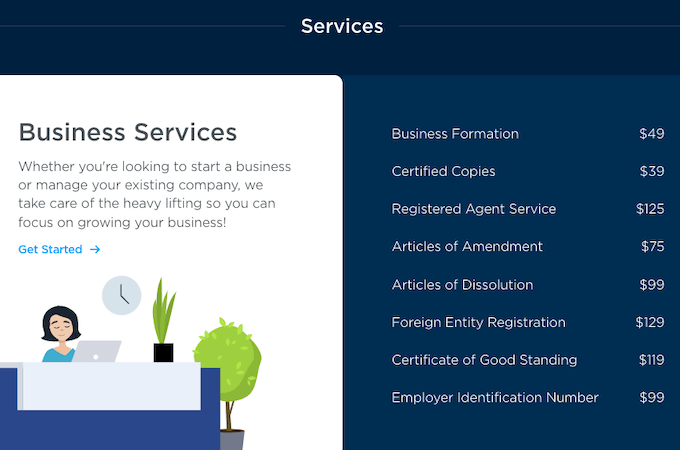
Best for: Founders who want affordable formation today and a practical legal/compliance toolkit they can keep using as the business grows.
If you want the best overall combination of value, flexibility, and ongoing usefulness, LegalNature is my top recommendation for 2026.
LegalZoom – Best for Full-Service Legal Add-Ons

LegalZoom is one of the most complete start-to-scale options for entrepreneurs who want a smooth, compliant launch and access to broader legal and tax help from one well-known platform. With decades in the category and support for LLCs, corporations, nonprofits, and partnerships in every state, it’s still one of the safest picks for founders who want a recognized brand.
The guided online flow is beginner-friendly, and the ecosystem goes far beyond filing: registered agent service, annual report filings, operating agreements, trademarks, business licenses, and tax services are all available in one place. That makes LegalZoom a strong pick if you expect to lean on add-on support as your company grows.
You can also bundle attorney help, tax guidance, or expedited processing. Whether you’re a first-time founder or formalizing a second venture, LegalZoom keeps the paperwork clean and gives you access to more hands-on help than many basic filing services.
What Makes LegalZoom Great
Depth and brand recognition. LLC filings start at $0 + state fees, and corporation filings typically start at $149 + state fees. If you want a big-name provider with layered legal, tax, and compliance options, LegalZoom remains one of the strongest choices in the category.
It’s also built for continuity: compliance alerts, document templates, and an integrated dashboard reduce the admin load so you can focus on customers and cash flow.

Best for: Founders who want a familiar, full-service provider with plenty of optional legal and tax help.
ZenBusiness – Best for Business Planning and Branding

Filing your company is step one. ZenBusiness helps with the next steps too—planning, branding, and getting online. Alongside a guided formation flow, you’ll find market research and grant tools, startup cost calculators, and options for a domain, website, and business email.
While many of these extras are paid add-ons, the convenience of having everything in one ecosystem is hard to beat—especially if you’re a first-time founder building the basics from scratch.
ZenBusiness also runs a strong registered agent service and scored high on my list of the best registered agent services, making it a versatile pick for launching and staying compliant.
What Makes ZenBusiness Great
ZenBusiness is designed to remove guesswork. You get document templates, domain privacy, a beginner-friendly website builder, and optional bookkeeping and tax filing help—including Money Pro for tracking invoices, payments, and expenses.
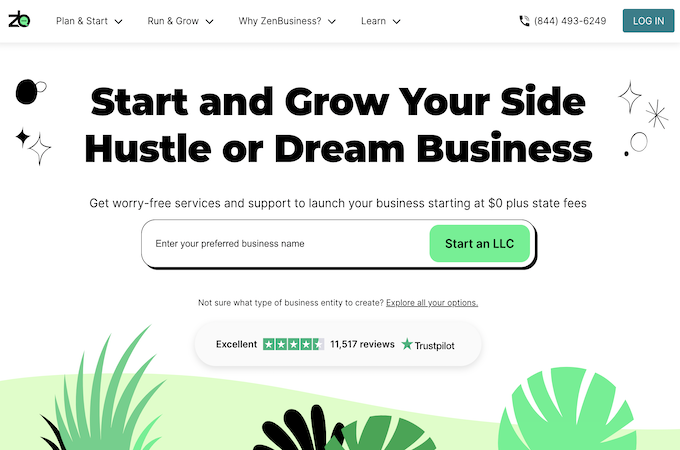
ZenBusiness pricing starts at $0 plus state fees for Starter. Pro is $199/year and Premium is $399/year (both plus state fees), with faster filing and added compliance tools; Premium also bundles a website, domain, email, and registered agent service.
Bizee – Best for LLC Filing
If you want the most affordable path to launch, Bizee (formerly Incfile) offers a free LLC filing—just pay your state fees. The step-by-step website keeps the process simple for beginners while still supporting more advanced needs.
Customization is solid, and select packages include a free EIN, a tax consultation, and an operating agreement. Every plan comes with a free registered agent for your first year, which removes a common early expense.
Bizee also handles incorporations (C-Corp, S-Corp) and nonprofits at the entry level, making it a compelling choice if you’re comparing entity types and want to keep costs low while you decide.
What Makes Bizee Great
It’s hard to beat “$0 + state fees” for a compliant filing, especially with responsive phone and email support (weekdays). For many single-member LLCs, the free tier covers the essentials; growing teams can step up to paid plans for extras and faster service.
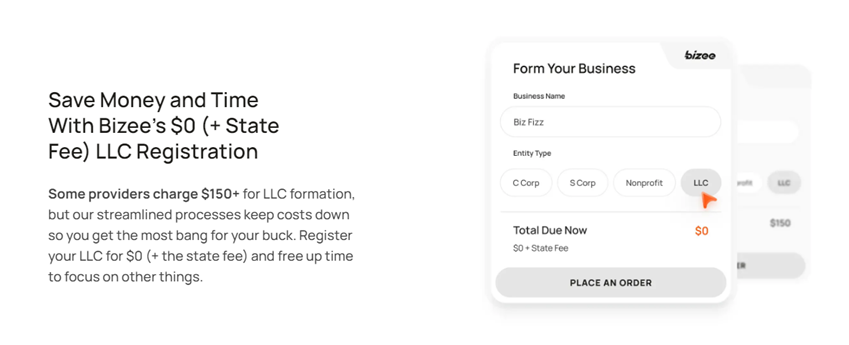
Bizee is free to start. Upgrades include Gold ($199) and Platinum ($299) + state fees. Gold adds a tax consultation, lifetime company alerts, and banking; many straightforward LLCs can start on the entry tier and upgrade later if needed.
Northwest Registered Agent – Best for Protecting Your Privacy
Northwest Registered Agent is privacy-first. As a registered agent specialist, it keeps your personal details off public filings wherever possible and uses its contact information as the default on communications.
Premium mail forwarding is available, and its Virtual Office service runs $29/month in many locations. Its “Privacy by Default” stance also means it doesn’t sell your data—reassuring if you’re wary of marketing lists and spam.
What Makes Northwest Registered Agent Great
Need even more separation between your home and business? The virtual office adds a business address, mail scanning/forwarding, and optional phone services. You can also add a dedicated VoIP number to keep your personal number private.

Northwest charges $39 + state fees to form an LLC or corporation and includes the first year of registered agent service; its registered agent service renews at $125/year.
Rocket Lawyer – Best for Ongoing Legal Support
Rocket Lawyer blends formation with real legal support. Attorneys are available by email, phone, or chat, typically responding within a business day to answer questions, review documents, or guide you through thorny issues as you operate.
There’s also a large self-serve library of state-specific resources and legal documents, but the real value is quick access to human experts when something isn’t clear. That’s why I consider Rocket Lawyer one of the best online legal service options for small businesses.
Non-members can purchase documents à la carte, but members unlock consultations/discounts and one free incorporation filing with discounted future filings. Membership is $39.99/month (with an annual option that lowers the effective monthly price).
Inc Authority – Best for Managing Your Business After Filing

Inc Authority offers a $0 LLC filing (pay only state fees) and packs in solid post-launch perks for your first year, including free registered agent service. Typical RA renewal runs around $179–$199/year after the free year.
As your needs expand, you can add website and domain services, business planning, and other operational tools. It’s a good way to launch cheaply and layer on support over time.
What Makes Inc Authority Great
Unlike some “free” services that push heavy upsells at checkout, Inc Authority’s $0 LLC tier is legitimately useful for lean startups. If you want more hands-on help, premium bundles add compliance notifications, record books, operating agreements, and domain + email.
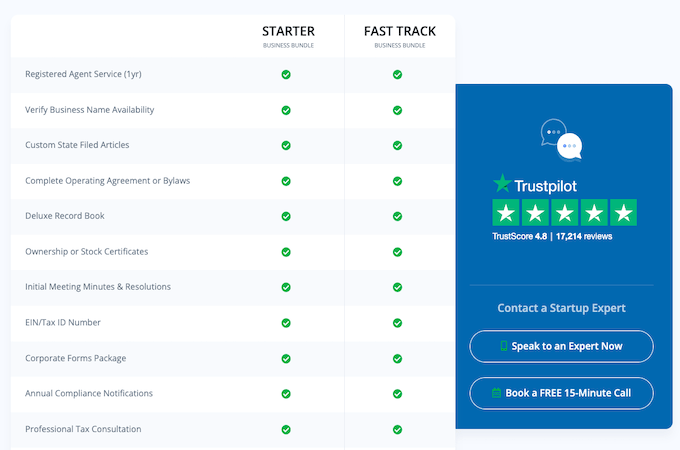
The easiest way to start is to file your free LLC and upgrade later if you need broader support.
MyCompanyWorks – Best for Quick Business Processing
MyCompanyWorks promises same-day processing on business days if you file before 3 p.m. ET; otherwise, it’s processed the next business day. Your state’s timing ultimately determines completion, but the quick hand-off here often trims days off the total.
MyCompanyWorks handles LLCs and corporations (nonprofits should pick another provider). The account setup is straightforward, and an interactive wizard keeps the filing flow simple.
What Makes MyCompanyWorks Great
Beyond speed, the platform is easy to navigate. MyCompanyForms—a library of frequently needed business forms—starts at $35 for lifetime access (or free with the Premium plan). You can also add company name changes, website setup, and virtual office services as needed.
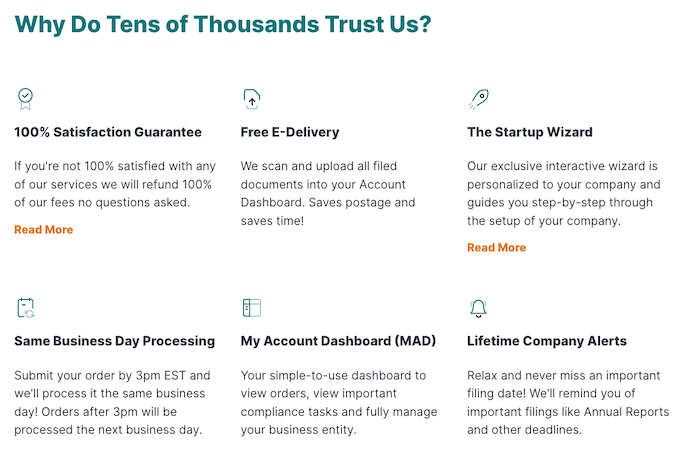
Basic filing starts at $59 + state fees. Entrepreneur ($179) adds MyCompanyForms, registered agent service, and an EIN. A 90-day satisfaction guarantee applies. The Complete package (from $259) includes MyCompanyWorks Premium—a full compliance bundle that normally runs $99 by itself.
Harbor Compliance – Best for All-Around Compliance
For multi-state operations or regulated industries, Harbor Compliance pairs intuitive software with hands-on specialists. Its database tracks changing state and federal rules, forms, and deadlines so you don’t have to, and the team can handle filings for you when needed.
The result is a single source of truth for licenses, registrations, annual reports, and entity records—ideal when non-compliance risks are high or internal bandwidth is limited.
What Makes Harbor Compliance Great
ComplianceAdviser can bundle audits, annual reports, registered agent service, and more into a custom plan. Even à la carte pricing is competitive—registered agent service commonly starts around $99/year for new customers— and you can start with formation and add compliance tooling as you scale.
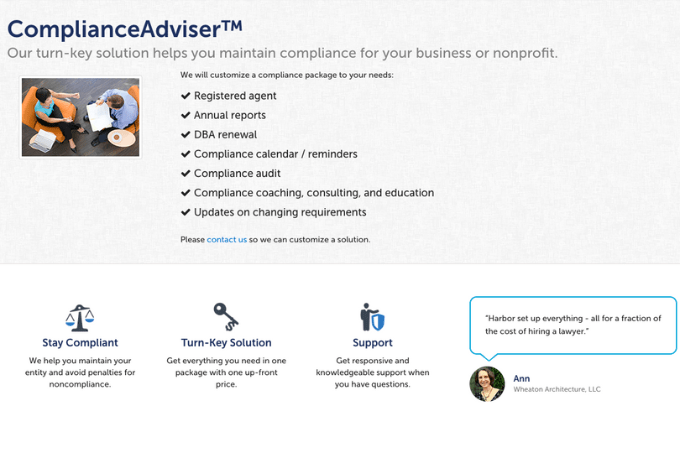
Business formation starts at about $99 + state fees. Compliance software isn’t bundled with basic formations; request a customized quote to combine tools and services. You can also start with a free compliance health check to identify gaps.
BizFilings – Best for Entrepreneurs and Startups

Entrepreneurs and startups appreciate how BizFilings (by Wolters Kluwer) holds your hand through the early steps. A startup wizard and checklists walk you through trademarks, licenses, and compliance, while the small-business toolkit helps you choose an entity and meet ongoing obligations.
When you’re ready, you can expand into business plan creation and sales tax registrations, or lean on the BizComply tool to store documents, track meetings, and stay ahead of deadlines with alerts.
What Makes BizFilings Great
It’s a comprehensive setup for small teams without in-house legal or HR. Support is available by phone, email, and live chat. Formations include three months of registered agent service free, after which RA renews (commonly around $220/year).

Business formations with BizFilings start at $99 + state fees and include a lifetime guarantee against filing defects.
Business Formation Services FAQs
LegalNature is a strong choice because it’s simple, affordable, and a true all-in-one formation service. Answer a few questions and LegalZoom handles the paperwork with your state, helps you get an EIN, and offers ongoing registered agent and compliance services if you want them.
The state fee to form an LLC ranges roughly from $35 to $500, depending on your state. If you use a formation service, you’ll also pay that provider’s fee. Don’t forget ongoing costs: many states charge annual report or franchise taxes that can range from $0 to a few hundred dollars per year.
Usually, yes—for liability protection and operational flexibility. By default, a single-member LLC is taxed like a sole proprietorship and a multi-member LLC like a partnership. Potential tax savings can exist if you later elect S-Corp taxation and pay yourself a reasonable salary, but that depends on your profits and payroll compliance—talk to a CPA to run the numbers for your situation and consider getting help from a reputable business formation service or attorney.
Not always. Single-member LLCs without employees can sometimes use the owner’s SSN for federal taxes. You must get an EIN if you have employees, choose corporate/S-Corp taxation, or need to file certain federal taxes. Many banks and payment processors also require an EIN to open accounts—even when the IRS doesn’t—so getting a free EIN from the IRS is often the smoother path.
It depends on your state—anywhere from a couple of business days to two weeks or more. Some providers submit your filing the same business day (e.g., before 3 p.m. ET with MyCompanyWorks), but state approval timing still controls completion. Northwest also submits quickly (their service fee includes a year of registered agent), and many states offer paid expedited processing if you’re in a rush.
Yes. You can create one LLC and operate multiple brands using DBAs (doing-business-as) under that LLC. This keeps administration simple, but it does not isolate liability between brands. If you want legal separation, use multiple LLCs or a holding company with subsidiaries. Always consult a lawyer and CPA before you decide.
An S-Corp is a tax election, not a separate type of company. You can operate as an LLC and later elect S-Corp taxation if it benefits you (often at higher profit levels). LLCs are simpler to form and manage; S-Corp taxation can reduce self-employment tax for some owners but adds payroll, reasonable-compensation rules, and extra filings. Get personalized advice from a CPA.
All 50 states require businesses to designate a registered agent to form a business. Your registered agent will receive service of process on behalf of your business and handle government correspondence related to your company. Requirements vary by state, so review my registered agent requirements by state before you file.